A paper is not the final destination. Living Science revisits influential research as new opportunities arise, making it possible to ask what still holds, what has changed, and why.
Read more about our approach and mission here.
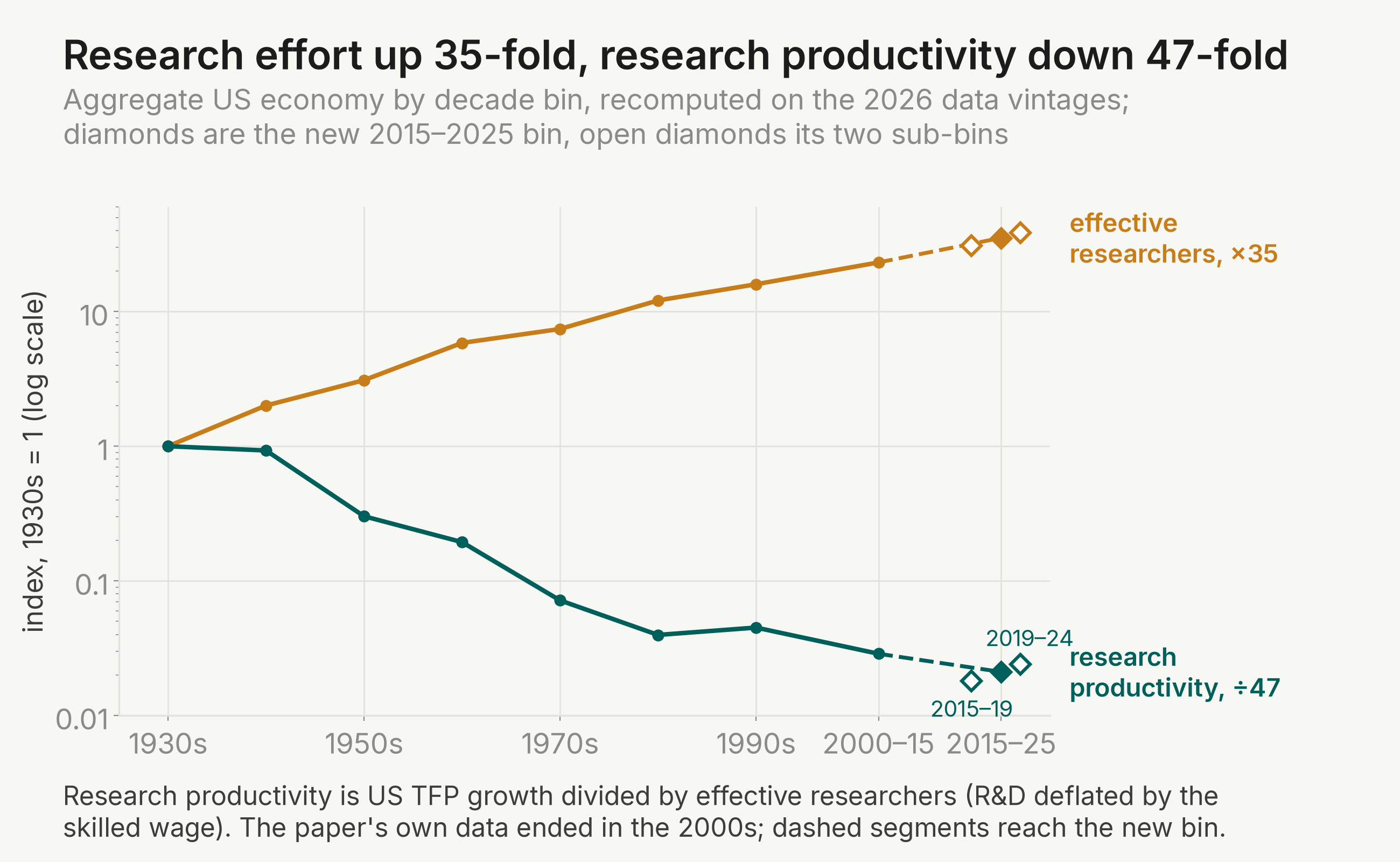
Are Ideas Getting Harder to Find?
Bloom, Jones, Van Reenen and Webb · American Economic Review, 2020 · data through 2025
Published · Last updated
Research productivity is still falling at close to the paper's rate once the pandemic years are isolated, and the first AI-era years bound AI's contribution to TFP growth between -1.1 and +3.8 points a year, an interval that contains zero.
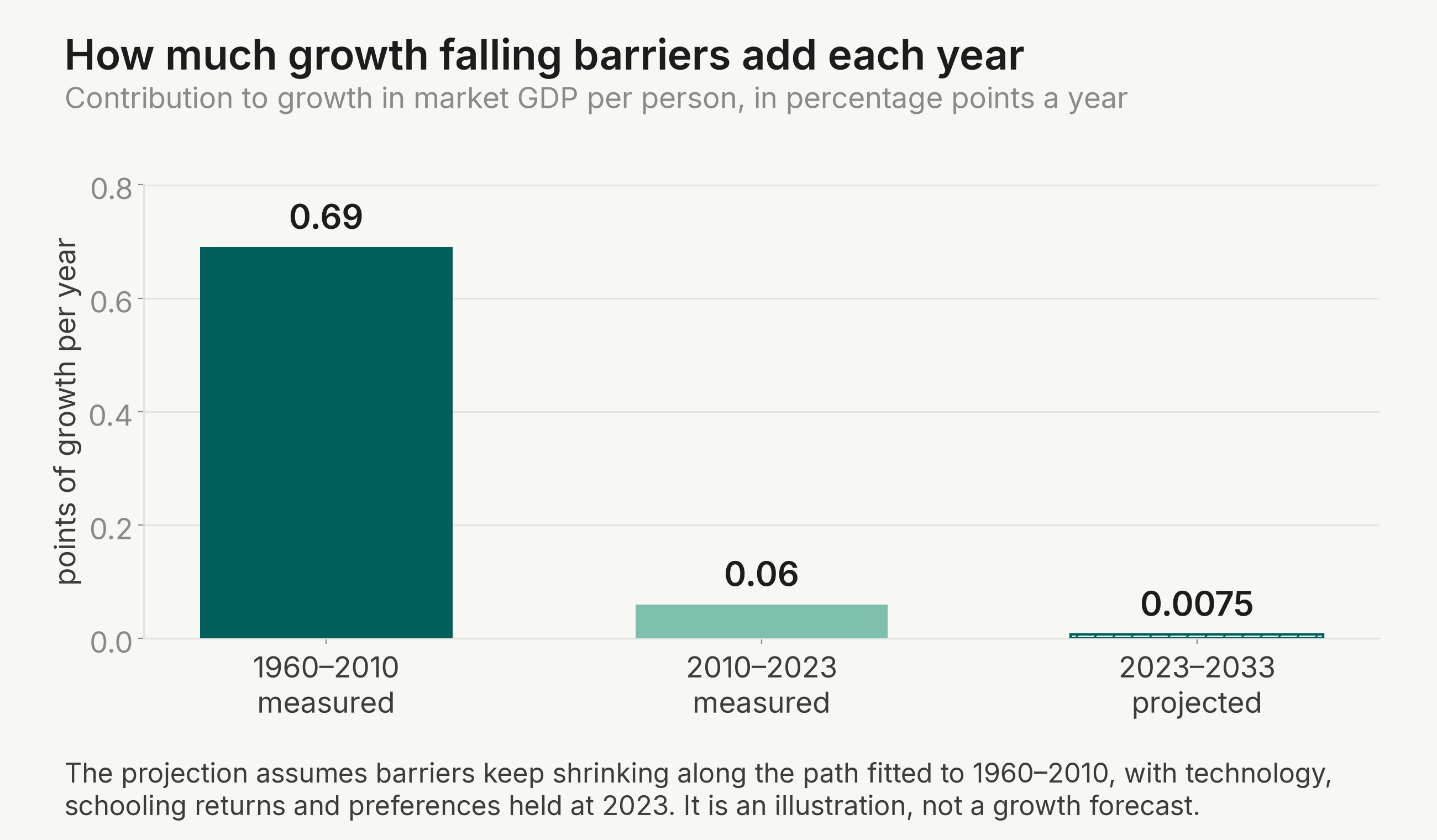
The Allocation of Talent and U.S. Economic Growth
Hsieh, Hurst, Jones and Klenow · Econometrica, 2019 · data through 2024
Published · Last updated
Frictions keeping people out of the right occupation kept falling after 2010 at about the same absolute pace, but the big reallocation is behind us: they now explain a few percent of growth, not the 40 percent of 1960-2010.

The China Syndrome
Autor, Dorn and Hanson · American Economic Review, 2013 · data through 2024
Published · Last updated
The import-competition effect on manufacturing jobs holds through 2012, fades to zero, then flips sign as the shock recedes. The lost jobs did not come back.

Reassessing the Ins and Outs of Unemployment
Shimer · Review of Economic Dynamics, 2012 · data through 2026
Published · Last updated
Hiring still drives unemployment, as the paper argued. The one exception is the 2020 layoff wave, which the paper's own framework predicted would look different.

Regional Evolutions
Blanchard and Katz · Brookings Papers on Economic Activity, 1992 · data through 2025
Published · Last updated
The main regional adjustment patterns persist through 2025. Migration accounts for 24–28% of the first-year adjustment after 2008, compared with 38% in 1978–90 on a comparable household employment basis.

The Effect of Minimum Wages on Low-Wage Jobs
Cengiz, Dube, Lindner and Zipperer · Quarterly Journal of Economics, 2019 · data through 2024
Published · Last updated
Still no detectable job loss through the fifteen-dollar era, but the central estimate drifts toward zero as states push into territory the original sample never saw.